
Stories
in English

Live Call

Tim woke up and looked at the ceiling. Then he remembered: today was his birthday. He pressed a button on the remote control.

A woman’s computer voice said at once, “Today is March 13, 2121. You are fourteen years old, Tim. Happy birthday. You also have birthday messages from Aunt Victoria, Uncle Paul, Max, Elina, your cousin Robert…”

Dina, Tim’s digital assistant, appeared as a hologram and continued reading the names of relatives and friends. They had all joined an automatic birthday service. When the list ended, loud old rock music filled the room. Tim thought people in the past really knew how to make exciting music.

Tim loved heavy rock, although his classmates laughed at him. They liked slow robot music. Tim did not care. Rock music made him feel alive. Dina knew his taste and played one of his favorite songs. Tim jumped out of bed and went to the kitchen, singing along.
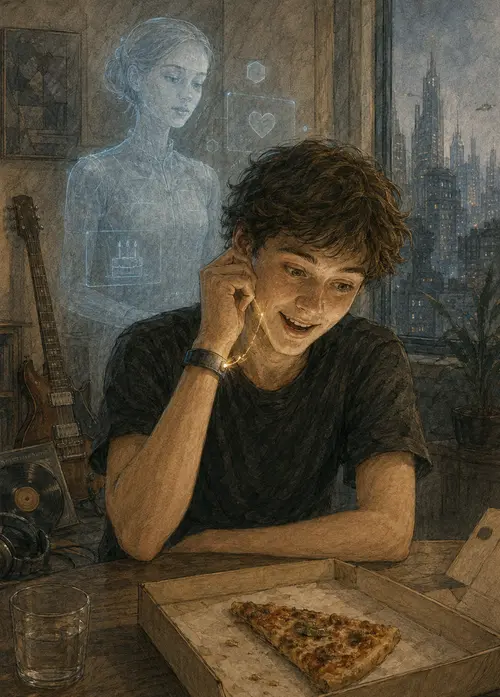
Dina followed him around the house. “Tim, because it is your birthday, you can miss school today. It is an official reason.”

Tim gave a happy shout. On the home screen he saw messages from his parents. His mother had drawn a big heart and a birthday cake. His father promised that on Sunday they would go to a new park and ride air bikes. In the evening, the family planned to celebrate with Tim’s favorite cake and a small laser show at home.

Tim was almost happy. Still, something bothered him. At first he did not know what it was.

He ate breakfast quickly and opened his favorite virtual game, Catch Me If You Can. After playing for about two hours, he suddenly understood what he was waiting for.

He wanted a real call.

Anyone could use the Live Call system. People wore a small sensor on their wrist. It counted how much time they spent talking to other people face to face. If two people talked long enough, the system allowed them to call each other directly.

On his birthday, Tim wanted one real call. He wanted to talk to someone, even by phone, without short automatic messages. But first he had to earn the call.

He thought about his friends and classmates. Who had he spoken to most during the last three months? School was now almost completely online. The Education Department said it was faster and safer than meeting in person. Dangerous viruses had ended the argument many years before. Fifty years earlier, the M-69 virus had killed a third of the world’s population. After that, most people accepted the new rules.

So Tim knew that his classmates Zack and Rita would not call. He talked to them online, but almost never face to face. Many teenagers were so used to virtual life that they avoided real meetings. Sometimes it seemed that they had forgotten how to talk to each other.

But Tim was different.

He loved ordinary conversations. When he looked into another person’s eyes and heard a real voice, he felt excited and happy. He smiled more. He wanted to talk and talk. Some people thought this was strange, but Tim did not care. He never missed a chance to speak to someone.

His chess teacher and guitar teacher also worked only online. Short meetings with different people did not help, because the system counted time with the same person. His parents did not count either; he saw them every evening.

By lunchtime, Tim almost wished he had gone to school. He fought virtual monsters, swam in the pool, listened to rock music, and argued with Dina for fun. She was always calm and polite, no matter what he said.

At four o’clock, he ordered a pizza with a real delivery person. It cost more, but it was his birthday.

To Tim’s great joy, Dan, a delivery driver he knew, came to the door. Dan wore a black T-shirt with the word PANTERA across it. At last — someone to talk to!

They started talking about their favorite rock music. Both of them became excited. When Dan finally left, Tim closed the door with a big smile.

Half an hour later, Tim was eating the last piece of pizza when Dina suddenly spoke.

“You have a Live Call.”

Tim almost choked. He quickly pressed the button.

A familiar voice said, “Hi, Tim! Happy birthday! Want to talk some more?”

“Yeah!” Tim could hardly believe it. “Dan, how did you know?”

“The Live Call system sent me a message. Surprised?” Dan asked proudly. “So, what do you want most for your birthday?”

“Dan, I can’t believe how happy I am to hear you! I want to break this stupid system. I hate it! Why could people in the past call anyone whenever they wanted?”

“Well, people slowly stopped talking to each other,” Dan said. “We got this problem from them, just like other problems. Global warming changed the planet. People are even talking more and more about moving to Mars. Our grandparents and great-grandparents left us a lot to fix, understand?”

“But that’s not fair!”

“Of course it isn’t.”

“You know what, Dan? When I grow up, I’m going to start a rock band. We’ll sing about unfair things. Very loudly. Will you come to a real concert?”

“Of course,” Dan said at once. “I’ll lie in the grass and sing badly with you.”

Tim smiled. His birthday was not so bad after all.
The Online Teacher

It was autumn on the east coast of America. It was dark and cold outside. At six in the morning, Marina’s phone alarm pulled her out of sleep and back into life during the pandemic.

She got up quietly. Her younger daughter was still sleeping under her favorite blanket. Marina walked to the bathroom and then to the kitchen. A thought appeared in her head: What do I have to do today?

She tried not to think about it yet.

Her phone was already in her hand. She felt she could not live without it now. Coffee came next. Maybe it did not really give her more energy, but she did not care. It helped.

While the coffee machine worked, Marina prepared breakfast and fed the cat.

“Here you are, Musya. Fish today. Lucky girl.”

Her sleepy husband came into the kitchen. They said hello, kissed quickly, and sat down to eat. Both looked at their phones. Marina checked social media.

Her husband read political news, perhaps to make sure the world had not completely changed during the night.

Marina looked at the clock.

“Almost seven! Girls, get up! Mum is late! Come on, little birds. Time for school!”

“I don’t want to!” came the usual answer.

After many calls and gentle pushes, Marina finally got both young girls into the kitchen. They were still in pajamas and hardly awake. She had to ask four times before they chose their breakfast cereal. While they ate and watched cartoons, Marina brushed their hair. Then she sent them to brush their teeth and get dressed.

Her older daughter, Masha, was in second grade and studied online from home. The younger one was in first grade. Marina drove her to her old preschool, where teachers helped children join their online classes.

Did I charge her tablet? Marina suddenly thought in the car.

She was very thankful to the preschool teachers. They spent half the day helping her daughter with online lessons. Marina could not imagine how she would manage without them.

She kissed her little daughter goodbye through a medical mask and drove home as fast as she could. She had to get back before Masha’s class started.

Marina ran into the house, opened the laptop, and joined Masha’s online classroom.

“Done,” she thought. “At least she is here. Now I have to go to my own classes.”

She quickly made the children’s beds, put breakfast plates in the sink, and hurried to her desk. She dropped into the chair and looked at her lesson plan.

“Six lessons today. Right. Let’s go.”

Marina taught English to children from first to eighth grade. Her students came from immigrant families, and she worked with them in small groups.

Her first class was sixth grade.

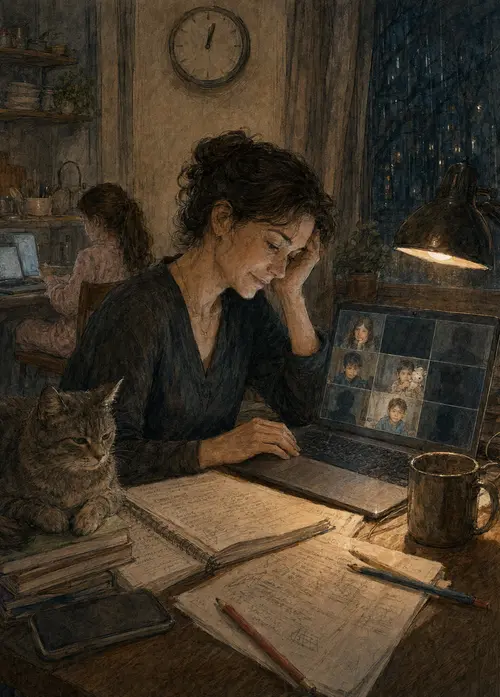
One by one, the students appeared on the computer screen. Marina thought of their little video boxes as warm holes in a deep forest. One box opened. A sleepy girl appeared, said hello, and then turned off her camera again.

Soon Marina could see only names and dark boxes.

She started the lesson.

“Last time we talked about father penguins and how they care for their eggs.

Who can tell us about it? José?”

Silence.

“José?”

Nothing.

“José?”

Still nothing. José’s box stayed dark and quiet.

Marina did not give up.

“Nelly?”

There was a noise, and then an annoyed voice said, “What?”

Marina repeated the question with her most positive teacher smile. She waited. But Nelly’s voice disappeared again.

“Mia, can you tell us how father penguins protect their babies from the cold?”

Mia finally turned on her microphone.

“Well… they keep them warm.”

“Excellent!” Marina cried, as happy as if she had won a prize.

She spoke for a few minutes about the hard life of penguins in Antarctica. Then she tried again to get an answer from one of the dark boxes. After several attempts, Adele turned on her camera. She was in pajamas and her hair was a mess. Marina did not mind at all. She was simply happy that someone was talking to her.

Marina explained the class task. She did not really expect everyone to do it. The children watched a video — or at least she hoped they watched it — while she rested her voice for a moment. Then she asked a few more questions and received almost no answers.

At the end of the lesson, she forced a tired smile and said goodbye.

The dark little boxes disappeared from the virtual school.

Marina immediately became Marina the mother again.

“Masha! You have maths! Go to class now!”

Masha closed a computer game and opened her school lesson. Marina did not have time to check anything else. She ran back to her own computer for the next group.

First graders.

They were the complete opposite of the sixth graders. They all wanted to talk at the same time. They did not listen to Marina or to one another.

“Teacher! Look! This is my dog!”

“This is my cat! We found her outside!”

“Teacher! Look! This is my magic stone!”

“My little brother has a birthday today!”

“Look at my new dress!”

They pushed every important object in their homes toward the camera. Marina smiled and asked simple questions about the pets, toys, clothes, and stones.

After ten noisy minutes, she finally calmed them down and started the lesson. But sounds from their homes came through the microphones: adults talking, doors closing, people laughing, and heavy things falling somewhere.

“Please turn off your microphones when you are not speaking,” Marina said again and gain.

Some children understood. Others did not.

Marina continued to teach over the noise. After ten minutes, her throat hurt from speaking so loudly. At last the lesson ended.

“Goodbye, everyone!”

But saying goodbye took another ten minutes. The children suddenly remembered many very important secrets.

“We’re going to buy presents for my brother! Don’t tell anybody!”

“Teacher! Why wasn’t Michael here today? I made a picture for him.”

“I have these candies! They’re so yummy!”

When Marina finally left the class, she held her head in her hands and sat without moving for a whole minute.

It felt like she had already worked a full day.

Then she looked at the time.

“Oh no.”

She was late again.

“Masha! Reading class! It has already started!” she shouted through the hall.

At the same time, Marina opened the link for her fifth graders. She relaxed a little when she saw that she was not actually late.

This class felt like a cool wind from the sea on a hot day. The children did not shout or interrupt. Most of them were polite and sensible. A few had already started to act like older students. They wanted to look cool in front of their friends, so they answered slowly and tried not to sound too interested. Still, Marina was grateful. They answered.

“Miss, can I read this page?”

“The main idea is that we really need water.”

“Miss, we already read this, but I can read it again.”

“The main character isn’t real.”

“Such good kids,” Marina thought warmly when the lesson ended.

Then she suddenly remembered Masha.

She ran to her daughter’s room. Masha was sitting in front of her school lesson, but she was also playing a computer game. Marina quickly closed the game windows, pointed a warning finger at her daughter, and rushed away to teach fourth grade.

Fourth graders were even easier. They were old enough to work on their own, but still young enough to enjoy school. They were sweet, friendly, and honest — most of the time. Marina smiled more during this lesson.

At the end she said, “Bye, kids! See you next time!”

Finally, lunch break.

Which meant: feed Masha, send her outside for fifteen minutes, help her with two school tasks, send her to the next lesson, check Marina’s students’ homework, read work emails, and prepare for seventh grade.

The seventh graders were a better version of the sixth graders. They usually answered questions. Sometimes they even asked their own. There were still quiet students, of course, but there were also very social ones.

Marina was thankful that they came to class at all. Homework was another story.

At last, only the third graders were left.

Then the internet stopped working.

“No. No, no, no. Not now!”

Marina grabbed her phone and quickly wrote to a coworker. She asked her to enter the class and tell the children that Marina had an internet problem.

The third graders usually came to class happily. They answered questions, asked silly things, and showed Marina their favorite toys and pets. She hated the idea that they were waiting for her.

The internet came back. Marina joined the class and started to apologize. One minute later, the connection disappeared again.

This time it did not return before the lesson ended.

Marina stared at the screen.

“Well. Great.”

Her teaching day was finished.

Except it wasn’t.

She still had to prepare the online materials for tomorrow. The lesson plans were already written for the whole week and had been sent to the school director. But she still needed to build each lesson online: make files, prepare tasks, find useful websites, and record short explanation videos.

That would take another two or three hours.

After that, she had to help her tired second grader with homework, pick up her younger daughter, and check the first grader’s homework too.

In the evening, Marina’s head felt heavy and her back hurt from sitting at the computer all day. She drove to the supermarket.

While she stood in line, she heard two women talking.

“How is your son doing with online school?” one asked.

“It’s hard,” the other woman said. “I have to watch him all the time, and I still have to go to work. Online school gives parents so much more to do.”

“Exactly! It’s the same in my family. Teachers are lucky, though. They sit at home. They don’t have to deal with children in school. They just give homework and grades. What an easy life!”

Marina suddenly coughed inside her mask.

Both women turned and looked at her with worried, suspicious faces.

Later that night, Marina put the children to bed and sat down at her desk again. She finished the work for the next day.

She went to bed after midnight. Her phone lay beside her, with the alarm set for six in the morning.

For a long time, she could not sleep. She thought about her lessons, her students, tomorrow’s plans, school reports, and better ways to explain difficult things.

“An easy life,” Marina whispered with a tired smile.

Then she fell into five hours of restless sleep.

A Fellow Russian

Freedom is the only reason that can justify our escape. Not the first reason, not the main one, not the most important one — the only one.
Sergei Dovlatov, “Marriage, Emigrant Style,” editor’s column, The New American

Love is a kind of slavery that is higher than freedom. It is the only thing for which we can give up our freedom without hesitation.
“Divorce, Emigrant Style,” editor’s column, The New American


I met Zinka at the Macarena bar. She was an attractive blonde with a long braid, thick mascara, and a small beauty mark above the right side of her upper lip.

Her husband, Leonardo, brought her there because I kept asking him to. He was born in Bolivia, studied in Moscow, and later moved to America. He worked part-time as a DJ at the bar and played energetic American and Latin music. He was a handsome dark-haired man and spoke three languages. His Russian always made me smile.

I loved dancing, so I liked Leo very much. But when I heard that his wife was Russian — and even from my part of the world — I became much more interested in meeting her. I persuaded Leo to bring her to the bar one Saturday. He refused for a long time because she did not like noisy places, but finally he agreed.

“I really don’t like bars,” Zinka told me. “All this noise, cigarette smoke, loud music. Leo loves being a DJ. It doesn’t bring much money, but he enjoys it.”

They had met in Moscow. Leo was studying computer technology at a university there. His father was a military general in Bolivia, and Leo, the youngest son, had been given a chance to study abroad. At that time, the family preferred socialist countries, so Leo chose the Soviet Union.

In his free time, he learned how to work as a DJ and played music at student parties on weekends.

Zinka had come to Moscow from Irkutsk, hoping to build a better life in the capital. She had finished a trade college and found work at a warehouse. She dealt with goods that were difficult to find in Soviet shops and managed to earn enough money for a small comfortable apartment in Novogireevo.

One evening she went to a student disco with her friend Lyuska. In those days people sometimes brought alcohol secretly, danced until late, and stopped only when the university staff came to end the party.

Lyuska introduced Zinka to the Latin American DJ. Zinka immediately liked him. They walked through the dark Moscow streets until morning, and that was the beginning of their romance.

When Zinka discovered that she was pregnant, Leo did the proper thing and married her. Soon they began to think about where to live. The Soviet Union was falling apart, Zinka’s workplace could close at any time, and Leo was going to receive his diploma in a month. There was little reason to stay.

With their baby daughter, they first went to Bolivia to meet Leo’s family. After that, they planned to try their luck in the United States.

Leo’s family welcomed Zinka warmly. They gave the young family the best room in the house, served wonderful food, and took them to the most beautiful places in the country.

But peaceful times do not always last. Leo’s father was losing his influence, the political situation was changing, and Bolivia no longer seemed completely safe. So the young couple applied for American visas.

Soon the little family landed at John F. Kennedy Airport and went straight to Connecticut, where some of Leo’s Latin American relatives already lived.

Leo immediately started looking for a job in computers. Zinka started watching soap operas to learn English.

A few months later, they found a good housing arrangement. The children of a very old Italian-American woman let them live in her house for free if they took care of their mother day and night.

Zinka now had a new role: half housewife, half caregiver. Leo spent hours at the computer, and on weekends he disappeared into the loud music and cigarette smoke of the bar.

“We live like we’re in a warm little swamp,” Zinka told her brother on the phone, sitting with her feet in pink fluffy slippers on the table. “We have everything — food, clothes, whatever we want. We don’t have many holidays or close friends, but life is calm. Nothing terrible happens.”

Their daughter grew up and started school. Zinka understood that their lucky housing situation would not last forever. The old woman was already 101 years old. So Zinka decided it was time to find a “normal” job.

Some Russian friends told me that a dental office was looking for an assistant, and I brought Zinka there. From the first minute, she seemed to belong. She learned quickly and behaved as if she had worked there all her life.

The old blonde Zinka disappeared. She cut her hair short and dyed it brown.

At work, she wore fashionable dark-red glasses “to look more professional.”

The dental office belonged to a married couple from Baku: the husband was a surgeon, and the wife worked in dental care. Zinka’s cheerful personality, quick mind, and easy way with people made her popular with both Russian-speaking and American patients.

The owners were happy with her. Later they even gave me discounts, perhaps because I had introduced Zinka to them. Or at least I liked to think so.

A successful business needs friendly communication, and Zinka gave them more than enough of that. She talked constantly with patients. In Russian, she spoke easily and naturally. In English, she spoke quite confidently, with a strong accent, funny phrases, and sometimes the wrong word.

But it worked. People left the office happy. Patients told her about family problems, daily life, books, films, and everything else.

One patient introduced Zinka to books about spirits and mysterious energy. Soon she was telling everyone who was willing to listen about the invisible world.

One day she took me to a seminar about “cosmic energy.” “If you send a message to the universe and ask for help, the universe will help you,” she explained. “Everything is in our heads. If you imagine your life in the right way, it will happen. Come with me — it’s interesting!”

Later, her interest in spirits was replaced by a passion for feng shui.

“If you live by feng shui, you can become successful and rich,” she told me.

“Do you know what happens if you put a mirror opposite the front door? All the good energy will leave your house through the mirror!”

People with an adventurous nature often find each other, even when they come from very different cultures. At the same dental office, a young American woman named Amanda worked at reception. She was a very large woman and was not the kind of person who spent much time thinking about life. Still, she enjoyed all the benefits that came with having a job and living in America.

Unexpectedly, she and Zinka became good friends.

One day Zinka complained that her legs hurt because of swollen veins. Amanda thought for a moment, handed Zinka her health insurance card, and explained exactly what to do.

So Zinka used Amanda’s insurance and received medical treatment for free. Later Amanda’s doctor was surprised and asked when Amanda had managed to get treatment for the veins in her legs.

Then one day Zinka became very nervous. Her old friend Yana, who had worked with her at the Moscow warehouse, was coming to America as a tourist.

Zinka could not allow Yana to think that she had failed in America. She quickly bought clothes and accessories from famous brands and lost five kilos.

Their historic meeting was going to happen in Manhattan — where else? — in a restaurant on the forty-eighth floor that slowly turned above the city.

“Are you going to invite Yana to your house?” I asked.

“Of course not! Maybe when we buy our own house.”

“That’s not very friendly.”

“So what? Here I can live quietly. Nobody cares what I do. Back home, everyone talked about me and told me how to live. I don’t want that again. The less she knows, the better.”

Immigrant life continued, slow and predictable, like a long line at a supermarket. Then, just before Christmas, Leo forgot to close something on his computer.

Zinka saw a secret on the screen: messages between Leo and a young woman in Russia. The woman was very confident and flirted openly with him. She and Leo were discussing how she might come to the United States.

Zinka exploded. She promised to make Leo’s life very exciting and began with a huge argument. The argument worked: Leo ran away to stay with relatives.

He called Zinka many times. He asked her to forgive him, said he understood his mistake, and promised that he had ended all contact with the woman.

Zinka enjoyed having power over him. She laughed and said:

“Just let him try to come home. I’ll kill him!”

I tried to calm her down.

“Come on, stop being angry. It’s almost the holidays. Forgive him. We can celebrate New Year together.”

“We can celebrate. He can’t. I’ll teach him a lesson! Let him try to come back! You should come, though. I bought herring. I’m making herring under a fur coat.”

On December 31, I drove to Zinka’s house in the early evening. Suddenly Leo ran out onto the front steps. His hair was a mess and his eyes were full of fear.

Behind him came Zinka. She was wearing hair rollers and a soft robe, and she was holding a whole herring in one hand.

She hit Leo on the back with the fish and shouted while he tried to escape.

“You terrible man! I’ll show you Angela! And Vika! And who else is there?!”

“Ow! Zina, forgive me! There’s nobody! Ow! Only you! I love you!”

“Why didn’t you remember that earlier, you hopeless woman-chaser?”

“Ow! I was stupid! Forgive me!”

“Not so fast! You’re going to behave now! Where are you going?”

They ran down the steps into the fresh snow. Leo slipped, fell hard, and cried out in pain.

Zinka’s angry face changed at once. She looked frightened. She dropped down beside him and began whispering confused words.

Leo had broken his leg.

The next day, Zinka was the first visitor in the hospital. She sat beside Leo’s bed and fed him herring under a fur coat with a spoon. She gently touched his hair.

“You silly thing. Is it good?” she asked.

Leo nodded happily. “Very good, Zinochka. Very good.”

Zinka smiled, fixed his pillows, and stayed by his bed for a long time.

Outside the window, snow began to fall again. Soft white flakes slowly covered the world — and, for a while, their anger and their arguments too.

Virtual Life

A gentle spring wind touched the faces of people walking in the park. The sun shone through the branches of trees that were waking after the long winter. A lazy street cat lay across the path, enjoying the warm light. A noisy group of sparrows attacked a piece of bread that someone had dropped. Everything seemed happy on that beautiful day.

On a bench sat a pretty young woman named Lena. She was completely lost in her new mobile phone. For her, nothing else existed in the dull real world. Inside the phone, however, life was bright, busy, and exciting.

Lena opened VKontakte and went to her page. She started checking everything that had happened during the last twenty-four hours: news, photos, and posts from her online friends.

Her fingers moved quickly across the screen. She had almost one thousand five hundred online friends, so the feed seemed endless, like the long list of names at the end of an American film.

It would have been one thing if all these people were real friends. But they were not. The social network kept suggesting more people: friends of friends, their friends, and then the friends of those people. Lena often sent a request, they accepted, and soon her list was full of hundreds of people she had never met and knew nothing about.

“Ah, this guy went to that new jazz club on Tverskaya yesterday,” Lena thought. “And this woman has already been on holiday in Turkey.”

The sparrows came closer to her feet. The bread was gone now, and they jumped around, looking for something else to eat.

“Who’s this? He’s cute… Oh, this photo is terrible… This woman says her boss gave her too much work. Well, what did you expect, darling? You want the money but not the work?”

The lazy cat woke up and looked carefully at the birds. They were busy near a small puddle, drinking dirty water and making a lot of noise.

“And these people had a great time at Tanya’s birthday. How nice of them — they didn’t invite me. Fine. I’ll remember that.”

Lena spent about forty minutes finding out who had done what and who had posted what. She liked photos and messages, added comments, and used different emojis whenever something especially interested her.

The cat was now fully awake. It lowered its body and prepared to jump at four sparrows. The birds did not seem to understand the danger. They continued their cheerful conversation.

Then Lena noticed that three people she hardly knew had birthdays that day. Of course, she had to congratulate them.

She sent all three exactly the same sweet birthday message. To make it look personal, she chose a different colorful background for each one. She was very pleased with her creativity.

The cat finally jumped, but the sparrows flew away without much effort. They landed only a short distance away and continued to chirp loudly, almost as if they were laughing at him.

Suddenly Lena decided she should post something interesting. She wanted all her friends, their friends, and everyone else to remember her and think, “What a fun girl!”

She chose a rainbow background with a decorative frame and wrote in large bold letters:

“I WANT COFFEE! NOW!”

Then she added a winking emoji. It was a joke, obviously.

An hour later, Lena saw a public post from a woman she used to work with.

“Driving in the morning is impossible. Slow turtles get on the road and make everyone late for work. Stay at home if you don’t know how to drive fast!”

Lena gave an approving little smile and pressed Like.

A young man sat down on the bench beside her. He watched the cat with interest. The cat was now trying to catch the bravest sparrow.

Then the young man happened to look at Lena. His face changed with surprise.

“Elena Sinichkina! Is that you?”

Lena jumped.

“Do we know each other? I don’t know you.”

“Of course we do! We’re friends on VK! I see your posts all the time. An hour ago you wanted coffee. And now you’re here! I can go and get you one. Just a minute!”

He stood up, ready to run.

For a second Lena did not know what to say. Then she called after him:

“No! Don’t! I was joking about the coffee!”

The young man stopped. He looked confused, then slowly understood that he did not need to go anywhere.

“Oh. All right… But if you want, I can still…”

Lena blinked and looked away, embarrassed. The young man recovered and smiled.

“My name is Dmitry. Dmitry Vorobyov. I’m a friend of Pyotr Shchepkin. You remember him, right? No? What about Maxim Novikov and his wife Zhenya? No? Maybe Olga Spiridonova? We all go to football matches together. And we talk on VK, of course.”

Lena shook her head at every name. She became more and more uncomfortable. The meeting had surprised her, and she had no idea what to say or how to behave.

Talking through a screen was much easier. Real conversation felt clumsy and difficult.

“Never mind,” Dmitry said easily. “I’m happy to meet you in real life. How are you?”

“Fine,” Lena managed to say. She was still trying to return from the online world to the real one.

“Look at that cat,” Dmitry said. “He keeps trying to catch that sparrow — the brave one. He tries from one side, then the other, but the bird always escapes. It almost looks like the sparrow is teasing him.”

“Yes, I see… Sorry, but I have to go. I have an event tonight. A company party at a restaurant. I need to get ready. Goodbye!”

She jumped up from the bench and hurried away. Her shoes made quick little sounds on the park path. The sparrows flew away from her feet.

“Bye!” Dmitry called after her.

He watched her go, clearly disappointed.

That evening, Lena arrived at the company party wearing a Gucci dress and her usual perfect makeup. She greeted every colleague she met with great energy and little air-kisses.

“Hello! We haven’t seen each other for ages! Are you on VK or Odnoklassniki? We need to connect. Let’s keep in touch!”

Then she moved to the next possible new “friend.”

“Hi! How are you? Which social networks do you use? Let’s add each other!”

By an unbelievable accident — perhaps one chance in a million — Dmitry Vorobyov entered the same fashionable restaurant at exactly that time.

He was with his friend Pyotr Shchepkin, who had started working for Lena’s company two weeks earlier. Pyotr had invited Dmitry to the company party. Their plan was to leave early and go to Pyotr’s home to watch the Argentina–Spain football match.

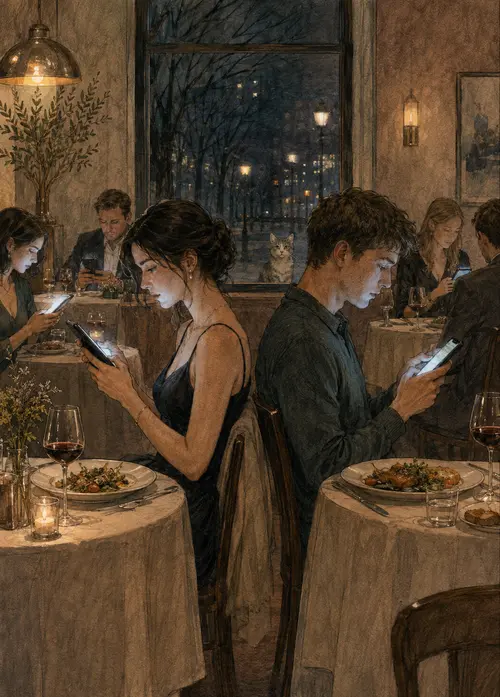
When the starters and salads arrived, the restaurant offered a strange picture. Young and not-so-young employees sat in front of beautiful food, wine, and other drinks. Almost all of them were looking down at their phones and talking to online friends.

Lena was quickly moving through her VK feed. She was searching through her long list of friends, trying to find the name of the man from the park.

Something about him had stayed in her mind. Maybe it was his smile. It had been warm and different. Now she regretted leaving so quickly.

Dmitry, meanwhile, was happily talking to Pyotr. He told his friend about the attractive woman he had met in the park that morning.

“If I ever meet her again, I won’t let her disappear so easily,” he said sadly.

In the dark restaurant, lit by the small blue-white light of phone screens, Lena and Dmitry were sitting at tables right next to each other.

But their backs were turned to one another.

Outside the window, the curious cat from the park seemed to look inside, as if it were trying to find a familiar face among all the strangers.